Star Child Care Foundation · Ghana

About us

We were founded by people who already knew the children.

Star Child Care Foundation is a Ghanaian organisation, staffed and led by Ghanaians, working to keep children out of institutions and inside families that can afford to raise them.

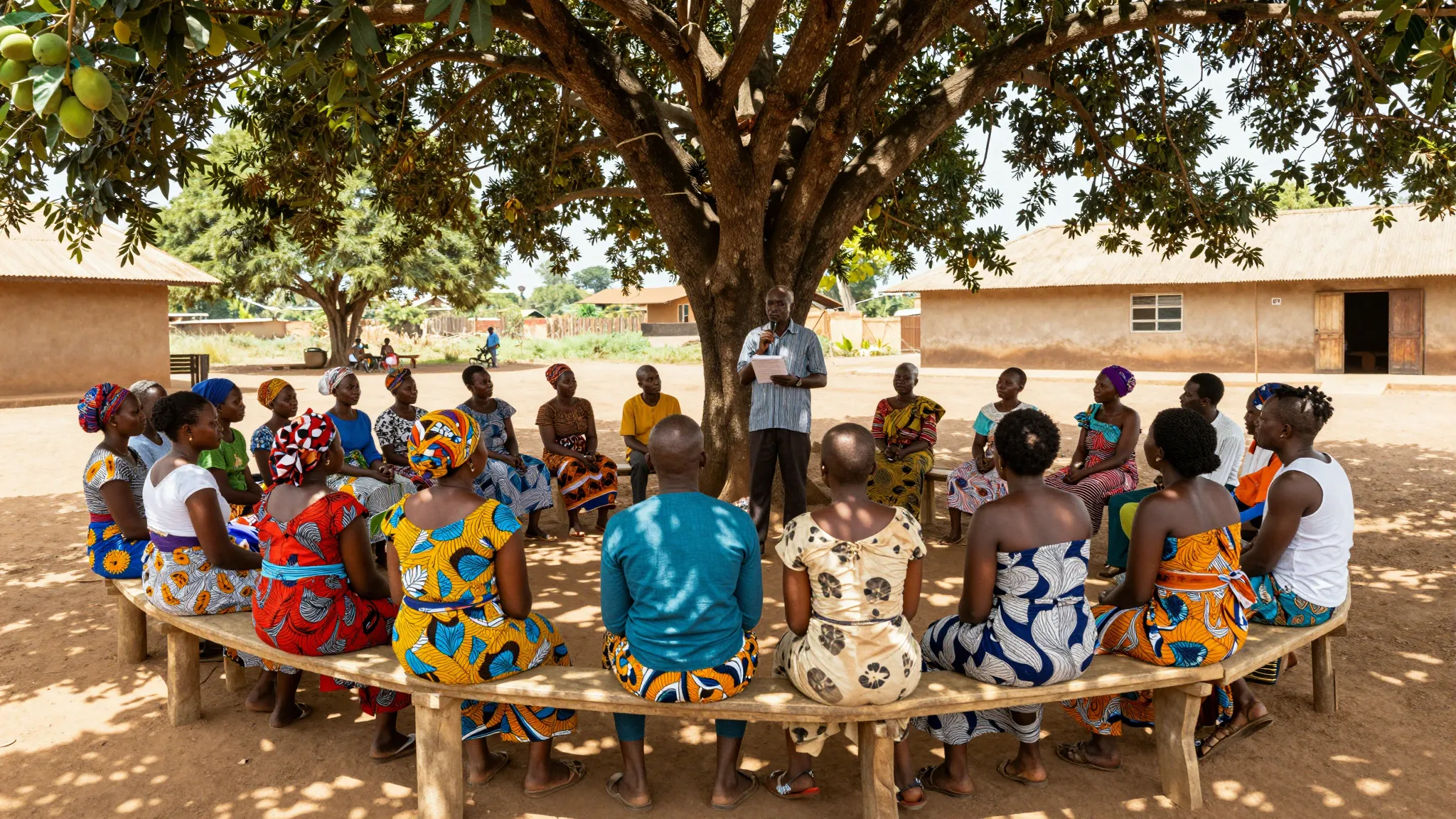
Community members seated in a circle under a large mango tree during a village meeting
A community entry meeting. No family joins a programme without one.

How we started

In 2011 four teachers and two community nurses in Koforidua realised they were keeping two lists of the same children.

One list was the class register. The other was informal — the children whose fees had gone unpaid for two terms, whose mothers had stopped coming to the clinic, who would soon be sent to an aunt in another region or to one of the private children’s homes that had opened along the Accra road.

The second list was almost entirely made up of children with living parents. What separated those families was not tragedy. It was a hospital bill, a failed harvest, a father who left, a grandmother who could no longer trade. Small amounts of money arriving at the wrong time.

We began by paying eleven children’s fees out of our own salaries. Fifteen years later we work with 26 communities across six regions, and the method has not really changed: find the children who are about to be given up, and remove the specific reason they are about to be given up.

Our name comes from Nsoromma, the Adinkra star — the child of the heavens, watched over through the night.

How we work

Five commitments shape every decision we make. They are the reasons we sometimes turn down money.

  • Family first, always

    We do not build or fund orphanages. Where a child has a parent, a grandparent, an aunt or an older sibling who can raise them, our job is to make that possible. Residential care is the last option, not the first, and it is always temporary.

  • Ghanaian staff, Ghanaian decisions

    Every one of our 14 staff is Ghanaian and most live in the districts where they work. Placement decisions are made by qualified Ghanaian social workers together with the district Department of Social Welfare — never by donors, and never from abroad.

  • Every community has a leaving date

    We enter a community on a three-year agreement with a named handover point: savings groups running on their own, school fees covered by household income, a district caseworker carrying the file. Two of our first communities no longer need us.

  • Children are not fundraising material

    We do not publish a child’s full name, school or village alongside their circumstances, and we do not photograph children in distress. Every photograph on this site is used with the consent of the person in it and of their caregiver.

  • The numbers are published whether or not they flatter us

    Our annual report includes what did not work. Two of the last three years contain a programme we stopped. We would rather lose a donor than describe a failed year as a success.

Child protection

A child-welfare organisation that cannot be trusted with children is worse than no organisation at all.

Every member of staff, trustee and volunteer is police-checked in their country of residence, references two previous employers, and signs our child protection policy before any contact with a child. Nobody works alone with a child who is not their own relative.

  • A named person, not a committee

    Our child protection lead is a qualified social worker and reports directly to the board. Concerns reach them within 24 hours and are logged whether or not they are upheld.

  • Children can report without an adult

    Every child on our roll knows two adults outside their household they can speak to, and the number of the district Social Welfare office.

  • No short-term visitors with children

    We do not host volunteer trips, school groups or donor visits that involve contact with children. Placements of six weeks or more, for qualified professionals only.

Reporting a concern

If you are worried about a child connected to our work, write to safeguarding@starchildcarefoundation.in.net. Concerns can be raised anonymously and are acknowledged within one working day.

Governance

We are a Ghanaian not-for-profit company limited by guarantee, governed by a board of five trustees who meet quarterly and are not paid.

  • Board of trustees

    Chair, treasurer, child protection lead and two community representatives drawn from the districts where we work. Trustee names, biographies and attendance records are published in the annual report.

  • Staff

    Fourteen people: a director, four social workers, three community health officers, two livelihoods officers, an accountant, a child protection lead and two field coordinators. Three are based in Koforidua, the rest in the districts.

  • Registration

    Registered with the Registrar-General’s Department as a company limited by guarantee and with the Department of Social Welfare as a non-governmental organisation. Registration numbers to be added.

  • Audit

    Accounts are audited annually by an independent Ghanaian firm and filed with the Registrar-General. The audited accounts are published in full each March.

Where our money comes from

Roughly two thirds from individuals, one third from institutions, and nothing from any source that wants to choose the children.

Most of our income is small regular gifts from people in Ghana, the Ghanaian diaspora, and supporters in the UK and United States. The rest comes from foundations and two long-running church partnerships.

We turn down funding that requires us to select children by faith, to photograph identifiable children for marketing, or to build residential facilities. We also decline gifts that would make any single donor more than a quarter of our income.

A full breakdown, including what each programme costs to run, is in our reports and accounts.

Come and see how it works

We are happy to talk to anyone considering supporting this work — including the questions that are awkward to ask.